Armenia was the testing ground
How Azerbaijan's conquest of Armenia gave Israel and America the green light for their own conquests in the Middle East
8 min read · 1,539 words

Intro
The rules-based international order is no more. The United States of America and Israel have decided that they need not play by international law; whereas in the past Israel and America made at least some attempt to manufacture public consent for operations, Israel's recent ethnic cleansing of Palestine and joint incursions with America into Iran have made no such attempt.
This article will draw a line from Azerbaijan's incursions against Armenia from 2016–2023 to Israel and America's incursions in the Middle East today, showing how international disregard for Armenians enabled these actions and how Armenia was a testing ground for the weapons of destruction used today by the two rogue states.
What happened in Armenia?
From 2016 to 2023, Azerbaijan incited numerous wars against Armenia and successfully ethnically cleansed a large portion of Armenian land—with zero international repercussions. Their initial goal was the extermination of Armenians from Artsakh—exonymically known as Nagorno-Karabakh—with their long-term goal of "complete elimination of Armenians".1
Artsakh was a region of Armenia, carved up by Stalin and given to Azerbaijan2 —despite over 94% of the population being Armenian.3 In 1988, the people of Artsakh voted in a referendum for their independence—99.89% in favour with 82.2% turnout.4 Soviet and Azerbaijani authorities ignored this referendum. During the collapse of the Soviet Union, the population of Artsakh gained their freedom in a war of independence.
Artsakh enjoyed relative stability for the next thirty years, with the first major incursion taking place in April 2016, also known as the "Four-Day War". Azerbaijan began shelling Armenian residential areas and captured an area of around 14 km² (5.4 mi²)—the first shift in the line of conflict since the initial ceasefire in 19945 —before Moscow stepped in and brokered a ceasefire.
During the next four years, Armenia underwent a color revolution. Then-prime minister Serzh Sargsyan's failure to act properly during the Four-Day War had come to light.6 Sargsyan was ousted and replaced by Nikol Pashinyan, a journalist-turned-revolutionary with no political or military background. Pashinyan invested heavily in anti-corruption, and let military investments lapse.
Azerbaijan spent those four years differently. They decided to heavily invest in weaponry, largely funded by America's $164 million "aid" packages, whose preconditions of ending the blockade against Armenia were waived by every president from 2002 to 2020.7
The Azerbaijani state and media ramped up their glorification of violence against Armenians, with Azerbaijani President Ilham Aliyev awarding a medal to an Azerbaijani conscript who beheaded a 19-year-old Artsakhi soldier and posted photos of his severed head on social media.8
On the morning of September 27, 2020, the Azerbaijanis began an offensive and again invaded Artsakh, this time successfully capturing several villages in Hadrut province.9 Thus began the Second Artsakh War, known colloquially in both Armenian and Azerbaijani as "The 44-Day War".
In September 2023, Azerbaijan launched "local anti-terrorist measures"10 , expelling the remaining over 100,000 Armenians from Artsakh11 .
Despite Armenia successfully defending Artsakh for 32 years, the Army of Azerbaijan forced capitulation in only forty-four days. How then, while Armenian forces were able to successfully defend their homeland for 9,679 days, did the Azerbaijanis steamroll over them in 0.45% of the time?12

Azerbaijan and Israel
The Israeli-Azerbaijani relationship is one of the most interesting political relationships of the 21st century. One would imagine a Jewish ethnostate13 and a secular Muslim14 ethnostate15 at odds with each other; however, they have formed one of the strongest arms partnerships in recent history.
President of Azerbaijan Ilham Aliyev himself described Azerbaijan's relationship with Israel as "like an iceberg, nine–tenths of it below the surface." 16 The below-the-surface part of this iceberg includes over $5bn in arms deals17 , providing Israeli intelligence services access to Iran18 , and 40% of Israel's crude oil needs.19
In 2011, the Azerbaijani state and Israeli defense contractor Aeronautics Defense Systems established Azad Systems, the first Azerbaijani drone manufacturing company, in a joint venture.20 Human Rights Watch documented multiple instances in 2020 where Azerbaijan used Israeli-made cluster munitions in residential areas, stating that Azerbaijan received the munitions from Israel in 2008–09.21 The military partnership between the two nations is so tight that Azerbaijan became the first international customer of Israeli defense contractor Elbit Systems' SkyStriker drone.22
Data from the Stockholm International Peace Research Institute shows Israel supplying 69% of Azerbaijan's arms imports between the Four-Day War in 2016 and the Forty-Four-Day War in 202023 , while Azerbaijan accounted for 17% of Israel's arms exports during the same period.24 An investigation by Haaretz documented 60 military cargo flights between the two during that period.25
Armenia as a Testing Ground
The 2020 Artsakh war became what military analysts describe as the "first war won primarily with unmanned systems".26
Azerbaijan used their newly purchased Israeli HAROP drones to automatically seek out and systematically destroy Armenian air defenses27 28 . Israeli LORA ballistic missiles were used to destroy critical military and civilian infrastructure29 30 31 , while Israeli Hermes 450, Hermes 900 and Orbiter unmanned aerial vehicles provided reconnaissance. Israeli-supplied Barak-8 missile-defense systems shot down Russian-supplied Iskander missiles launched by Armenia to defend its territory32 , while modernized T-72 tanks rebranded as "Aslan"—the Azerbaijani word for "lion"—fronted attacks on Armenian positions.33
Israeli armaments used by Azerbaijan were used operationally, allowing performance feedback and data collection to inform new generations of Israeli weaponry.34
Azerbaijan went after Armenian cultural sites, attempting to eradicate any evidence of the region's native Armenian population.35 They shelled Armenian churches36 37 , destroyed Armenian cemeteries38 , bombed civilian centers39 , and even wiped multiple Armenian villages off the map.40 41
Artsakh became a proof-of-concept, a live military tech demo. Azerbaijan showcased the military prowess and effectiveness of Israel's new weaponry, and unveiled to the world how these weapons could be used for new forms of warfare. The newly displayed doctrines of psychological attrition, remote strikes, and weapon systems became normalized across other conflicts.
International Silence—Setting Precedent
In response to this treachery, the world went mild. Governmental bodies were "concerned"42 43 44 45 46 47 48 49 50 51 52 53 54 55 56 57 58 59 and "urge[d] both sides"45 46 47 50 51 52 53 55 56 58 60 61 to "peacefully" end the conflict. They asked "both sides" to "peacefully" end an invasion and ethnic cleansing started wholly by one side.
Measures taken by the International Court of Justice62 were ignored by Azerbaijan,63 establishing that "legally-binding" international mechanisms were, in fact, not legally binding.
The non-action from the world proved that spurious military action no longer carried international consequences. The liberal rules-based international order was dead. So long as their objectives were achieved quickly enough, state actors were free to do whatever they pleased without fear of repercussion. Condemnation may follow, but punishment may not.
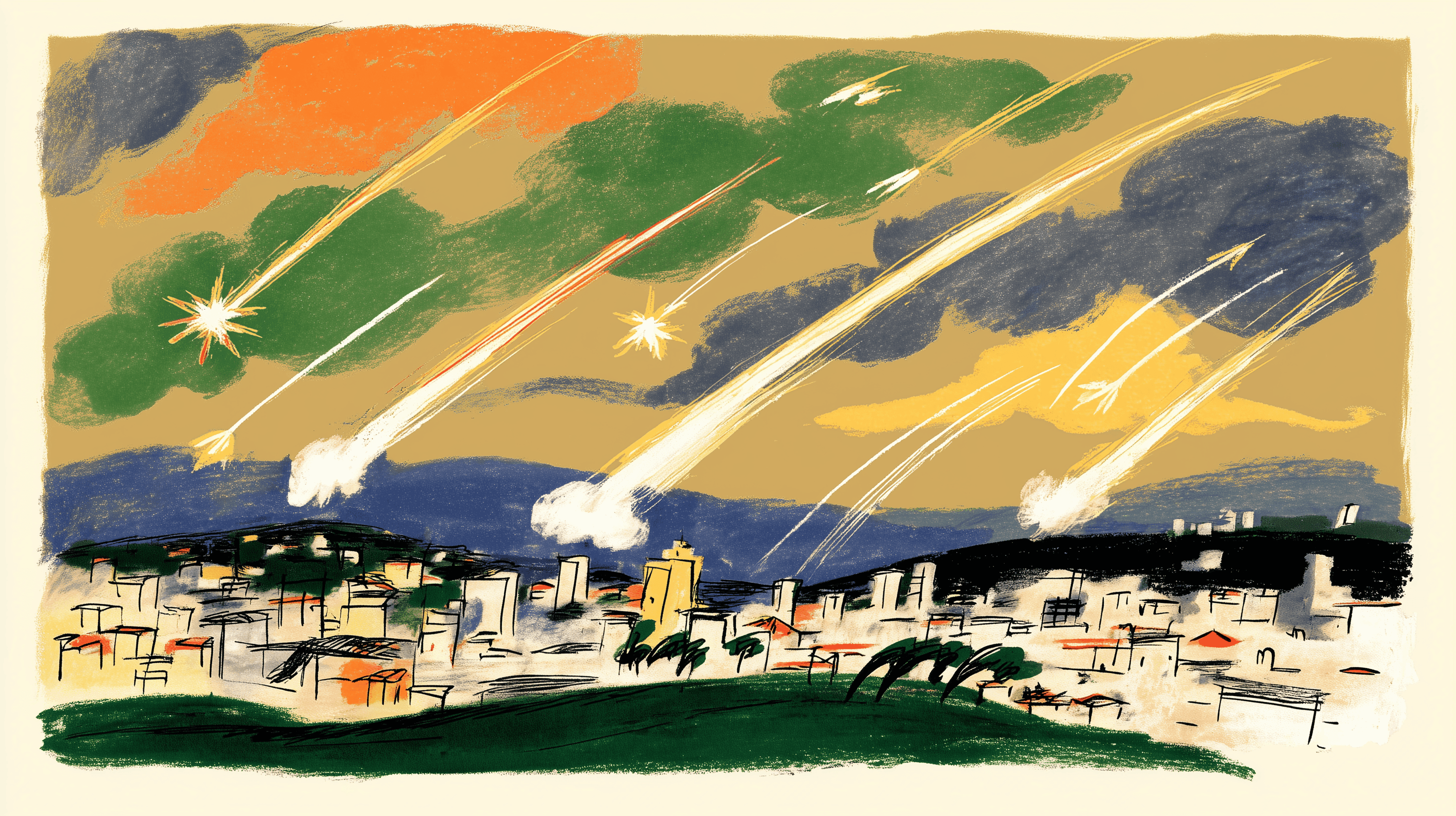
Israel and the Final Frontier
This newfound global spinelessness confirmed in the eyes of Israel that the world would not care about their plans to ethnically cleanse Palestinians and neighboring populations.
The Open Source Munitions Panel catalogued the same weapons being used by Israel in Gaza during Israel's genocide of Palestinians as being used by Azerbaijan in its eradication of the Armenians in Artsakh.64 Israel used the same white phosphorus munitions in Gaza and Lebanon65 66 as Azerbaijan did in Artsakh67 . Palestinians and Armenians were severely dehumanized by their respective aggressors.68 69
Drawing from Azerbaijan's blockade of Artsakh70 71 , Israel tightened its existing blockade of Gaza to famine-level malnutrition.72
Like the reactions to Azerbaijan's conquest, leaders found Israel's incursions "concerning". 73 74 75 76 77 78 79 Like the response to Azerbaijan's conquest, no formal action was taken against Israel—no military interventions, no sanctions, and no glassing of their capital city, as they themselves had done to so many others.
Israel began a new war with Iran, killing diplomats80 81 and a head of state82 —seemingly unprecedented, until the leniency of the world against Israel's previous actions is factored in. Just as Azerbaijan attacked Armenian schools83 , Israel targeted and leveled Iranian schools84 .
Even as this article is being finalized, Israel has begun a massive new incursion in Lebanon, carpet-bombing the capital city of Beirut, killing hundreds of civilians.85 Will Israel see consequences for this?
Final Words
The suffering of the Armenian people is oft overlooked, warning signs ignored, and cries for help unheard. Yet as often as it is, the suffering of Armenians preempts suffering elsewhere.
This pattern predates the ethnic cleansing of the Armenians of Artsakh. Persecution of Armenians in the Turkish Republic opened the doors for the attempted Kurdish elimination. Restrictions on language, capital, and life passed along from Armenians to Kurds. The Hamidian Massacres in the mid-1890s, where 300,000 Armenians were killed in the Ottoman Empire by order of Sultan Abdul Hamid II led to repression of Christian minorities across the Ottoman Empire. Most famously, the Ottoman extermination of 1.5 million Armenians, a mass killing so bad it led to the creation of the word genocide, directly inspired Adolf Hitler to commit the Holocaust.
The plight of Armenians seldom attracts any attention, yet their torment is the canary in the coal mine. In order to understand the methods used to eradicate populations, one must pay attention to how the Armenians were eradicated; and in order to prevent the eradication of other populations, we must prevent the Armenians from being eradicated. Armenia has historically been the testing ground for further mass conflict. We must intervene when Armenians are targeted, not after the methods have been exported elsewhere.
Who, after all, speaks today of the annihilation of the Armenians?86
—Adolf Hitler

Baku Mayor Hajibala Abutalybov to a Bavarian delegation: "Our goal is the complete elimination of Armenians. You, Nazis, already eliminated the Jews in the 1930s and 40s, right? You should be able to understand us." Congressional Hearing Record, p. 50
"The Soviet Union created the Nagorno-Karabakh Autonomous Region within Azerbaijan in 1924 when over 94 percent of the region's population was Armenian." Azerbaijan: A Country Study; US Library of Congress Federal Research Division
The Referendum on Independence of the Nagorno Karabakh Republic (archived); Republic of Artsakh
The Nagorno-Karabakh Redux; Licínia Simão, European Union Institute for Security Studies
The April War: A Treason and a Great Conspiracy Against the Armenian People, ¶ 9 (in Armenian); Factor
Ending US Military Assistance to Azerbaijan Immediately, ¶ 4; Responsible Statecraft
Risk Factors and Indicators of the Crime of Genocide in the Republic of Artsakh, p. 36; Lemkin Institute, Genocide Watch
As Fighting Rages, What Is Azerbaijan's Goal?, ¶ 4 ; Joshua Kucera, Eurasianet
"Therefore, local anti-terror measures have been launched…" Statement by Azerbaijan's Ministry of Defense, 19 September 2023 13:22 ¶ 5 ; Ministry of Defense of the Republic of Azerbaijan
Armenian Exodus From Nagorno-Karabakh Tops 100,000; UN Readies for Visit; Radio Free Europe
Calculated from the end of the First Artsakh War (12 May 1994) to the end of the Second Artsakh War (10 November 2020). Artsakhi forces still held sizable territory for another three years before total capitulation.
Netanyahu Says Israel Is 'Nation-State of the Jewish People and Them Alone'; Bill Chappell and Daniel Estrin, NPR
Azerbaijan: Islam Comes with a Secular Face; Shahla Sultanova, Eurasianet
Schools for Some, Repression for Others: How Ethnic Minorities Live in Azerbaijan (in Russian); Magerram Zeynalov, BBC
Israel has sold us $5 billion worth arms, Azerbaijan; commonspace.eu
Azerbaijan supplied Israel with 40% of its oil during Gaza war, report finds; Open Caucasus Media
"The state industry's first major project was the establishment of Azad Systems, a joint venture between Azerbaijan and Israeli drone manufacturer Aeronautics, in 2011." Azerbaijan Looks to Greater Reliance on Domestically Produced Weapons ¶ 14; Zaur Shiriyev, Eurasianet
Azerbaijan: Cluster Munitions Used in Nagorno-Karabakh; Human Rights Watch
"According to the AzeriDefense website, Azerbaijan is the first international customer of the SkyStriker." Israel's Elbit Systems sells Azerbaijan SkyStriker suicide drone; The Jerusalem Post
Azerbaijan Praises 'Very Effective' Israeli Drones in Fighting with Armenia; The Times of Israel
The Air and Missile War in Nagorno-Karabakh: Lessons for the Future of Strike and Defense, ¶ 6; Center for Strategic and International Studies
The Air and Missile War in Nagorno-Karabakh: Lessons for the Future of Strike and Defense ¶ 10; EVN Report
Azerbaijan: Unlawful Strikes in Nagorno-Karabakh; Human Rights Watch
Israel and Azerbaijan: Trusted Friends and Reliable Partners, ¶ 5; The Middle East Institute
Israel's Massive Supply of Sophisticated Weapons to Azerbaijan, ¶ 10 ; Armenian Weekly
Successes in conflict and new anti-radar features signal the future of drone warfare; Airport Technology
Armenian monuments in line of fire in Nagorno-Karabakh conflict; The Art Newspaper
Azerbaijan demolished the Surb Hovhannes Mkrtich (Kanach Zham) Church of Shushi, reducing it to rubble; Monument Watch
Armenian cemetery in Azerbaijani-occupied Mets Tagher village destroyed; Public Radio of Armenia
File: Stepanakert bombardment by Azerbaijani forces on October 4, 2020 during the Nagorno Karabakh war; Wikimedia Commons
Complete destruction of the village of Karintak by Azerbaijan; Monument Watch
Nagorno-Karabakh: Armenian Refugees; UK Parliament
Joint statement on Azerbaijan's attack on Nagorno-Karabakh; European Parliament
Preocupación argentina por los enfrentamientos entre Armenia y Azerbaiyán; Cancillería Argentina
Joint statement by Canada and the United Kingdom on the Armenia-Azerbaijan conflict; Government of Canada
Georgia concerned with resumption of hostilities between Armenia, Azerbaijan; Georgian State Media
Armenia-Azerbaijan war rages on for fifth day, India voices concern and calls for restraint; ZNews
Perang Armenia vs Azerbaijan, Ini Sikap RI; CNBC Indonesia
Statement of the Ministry of Foreign Affairs of Kazakhstan in connection with the escalation of the Armenian-Azerbaijani conflict; MFA Kazakhstan
Conflict militar între Armenia și Azerbaidjan în regiunea Nagorno-Karabah; Radio Free Europe
Gobierno del Uruguay expresa preocupación por escalada de violencia en la región de Nagorno - Karabaj; MFA Uruguay
Summary of the Order of 22 February 2023; International Court of Justice
Statement on Azerbaijan's Noncompliance with February 22nd ICJ Order to Unblock Lachin Corridor; Lemkin Institute
Israel: White Phosphorus Used in Gaza, Lebanon; Human Rights Watch
Lebanon: Israel Unlawfully Using White Phosphorus; Human Rights Watch
Azerbaijan's Dehumanization of Armenians Echoes Horrors of Holocaust; The Times of Israel
In Israel, rhetoric dehumanizing Palestinians and calls for eradicating Gaza have become commonplace; Le Monde
Israeli military operation in Rafah in the Gaza Strip (Statement by Press Secretary KOBAYASHI Maki); Japanese MOFA
G7 Italy 2024 Foreign Ministers' Statement on the Situation in the Middle East; U.S. Embassy & Consulates in China
Kamal Kharazi, ex-top diplomat dies from wounds sustained in US-Israel 'terrorist attack'; TRT World
Four Iranian diplomats killed in Israeli attack in Lebanon on Sunday, Iranian state media says; Reuters
AD HOC REPORT ON THE CHILDREN RIGHTS AFFECTED BY THE AZERBAIJANI ATTACKS AGAINST THE REPUBLIC OF ARTSAKH (NAGORNO-KARABAKH); Human Rights Ombudsman of the Republic of Artsakh
Israeli strikes kill more than 300 people in one day in Lebanon, saying Iran truce doesn't apply; PBS NewsHour
Adolf Hitler's Obersalzberg Speech; Armenian National Institute